
Miner Hosting Contracts: What to Check Before Signing
A hosting contract is a price per kilowatt-hour wrapped in a paragraph of conditions. At 20 J/TH a 1000 TH/s fleet burns 480 kWh a day, so two cents on the tariff is $9.60 a day, or $288 a month — bigger than most of the line items the contract talks about. Read the tariff clause first, then the clauses that decide how many days you actually run.

Key takeaways
- At 20 J/TH the breakeven tariff is about $0.0841/kWh gross and $0.0808/kWh after the listed 4% PPS+ fee — a host above that line cannot leave you a margin.
- A 1000 TH/s fleet earns about $40.39 a day gross and $38.77 after that fee, against $28.80 a day of power at $0.06/kWh.
- Downtime is billed in lost output: one idle day at 1000 TH/s is roughly $38.77 of net income, so an uptime credit is a repayment term, not a courtesy.
- Check who insures the machines, who pays return shipping on exit, and whether the tariff can be raised inside the term.
The tariff clause and its escalation
Every hosting contract states a power price and almost every one allows that price to change. The question is by what mechanism and after what notice. A pass-through of the utility's published industrial rate behaves differently from a formula indexed to a national average, and both behave differently from a rate the operator can set at renewal. Ask for the clause in writing, ask how much notice precedes an increase, and ask whether you may terminate without penalty if the increase exceeds an agreed threshold.
Then test the number against breakeven. A machine at 20 J/TH consumes 0.48 kWh per TH/s per day, so the gross income of $0.0404 per TH/s per day covers a tariff of $0.0841/kWh before any fee, or $0.0808/kWh after the listed 4% charge on the block-reward component. Above that tariff the machine is under water at today's difficulty, and no uptime credit fixes a negative margin.
Uptime, curtailment and who absorbs the interruption
Uptime clauses come in two shapes: an availability target with a service credit, or a best-efforts promise with nothing attached. The first is measurable and the second is not. Ask how interruption is defined, whether scheduled maintenance counts against the target, and how many hours per month are permitted before a credit accrues. Then convert the credit into the money it replaces: at 1000 TH/s a full day of downtime costs about $38.77 of net income, so a credit worth a day of hosting fees does not cover the loss.
Curtailment needs its own paragraph. Sites in constrained grids are sometimes paid or instructed to reduce load during peak hours, and that is a legitimate arrangement as long as the contract says who keeps the compensation and whether the interruption counts against the uptime guarantee. If the site keeps the curtailment payment and the downtime lands on your availability record, you are absorbing the downside of an arrangement you are not paid for.
Maintenance scope, liability and exit
Maintenance clauses should name the turnaround time for a failed hash board, state whether spares are held on site, and say who pays for shipping and for parts outside warranty. A vague commitment to repair is worth less than a stated number of days. Ask as well about firmware policy: a host that applies its own overclocking profiles to chase hashrate benchmarks may void a manufacturer warranty that you, not the host, rely on.
Two clauses rarely read until they matter are insurance and exit. Confirm who insures the machines against fire, theft and water damage, and at whose valuation; confirm what notice you must give to leave, how machines are returned, and who pays the freight and any de-installation fee. An exit that takes four months and a shipping invoice is part of the effective price of the contract. If the machines were financed, that exit timing also has to line up with the repayment schedule, which is the same discipline that applies to Collateral-Pledged Loans where the pledged hardware has to be released when the balance clears.
| Clause | What it should state | Figure that tests it |
|---|---|---|
| Power tariff | Rate per kWh, metering point, escalation formula, notice period | Breakeven about $0.0841/kWh at 20 J/TH, $0.0808/kWh after the listed 4% fee |
| Uptime and credits | Definition of interruption, permitted hours, credit rate | One idle day at 1000 TH/s is about $38.77 of net income |
| Curtailment | Who is compensated, whether it counts as downtime | 480 kWh a day at 1000 TH/s at 20 J/TH |
| Maintenance | Turnaround days, on-site spares, shipping responsibility | Each idle day costs more than a month of that machine's power |
| Insurance and liability | Cover, valuation basis, who claims | Replacement cost of the machines at declared value |
| Term and exit | Notice period, de-installation fee, freight | Months to recover machines versus loan repayment dates |
Worked example: the same contract at two sizes
Take a 1000 TH/s fleet at 20 J/TH and a 10 TH/s rig at the same efficiency, both hosted at $0.06/kWh. The large fleet produces $40.39 a day gross, or $38.77 after the listed 4% charge on the block-reward component. Its power draw is 480 kWh a day, costing $28.80, which leaves about $9.97 a day and $299 a month of margin before management fees.
The small rig produces $0.40 a day gross and $0.39 net. Its 4.8 kWh a day costs $0.29 at the same tariff, leaving about $0.10 a day, or $3 a month. Raise the tariff to $0.07/kWh and the large fleet keeps $5.17 a day while the small rig keeps $0.05 — the same clause, two very different outcomes, because fixed consumables around a small machine do not scale down with it.
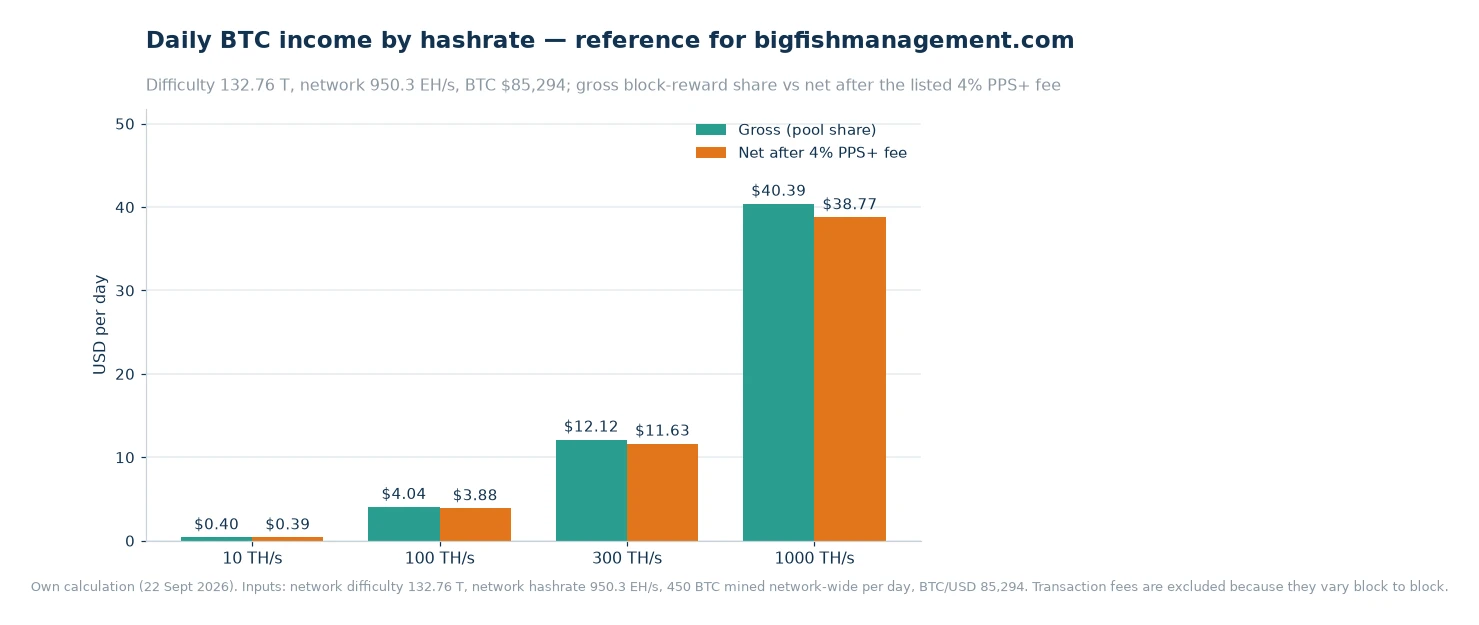
That comparison is also the argument for reading a contract against your own hashrate rather than someone else's review. A clause that is tolerable at 1000 TH/s can be fatal at 10 TH/s, and the clause itself looks identical in both documents.
Both sizes also assume today's difficulty holds. The next adjustment is estimated at about +1.90%, which trims every daily figure by a similar share and stretches any payback horizon: the contract does not change, but the margin it leaves does.
Who to sign with, and what to bring to the call
The practical use of a directory of Mining Companies is that it puts several hosts side by side before any machine leaves your possession, so the tariff clause and the uptime credit can be compared on the same page rather than negotiated one at a time. Bring your own numbers to that comparison: hashrate, efficiency in joules per terahash, the power tariff on offer and the net daily income at current difficulty.
Start with the ViaBTC Mining Companies listing for hosts and suppliers, and use the Miner Profitability Ranking to check what the model you intend to place actually earns per day at today's price and difficulty. A host whose contract survives those two checks is worth a site visit.
Frequently asked questions
What should an uptime guarantee actually promise?
A defined availability percentage, a stated number of permitted interruption hours per month, and a credit that is measured against your lost output rather than against the hosting fee.
Can a host raise the power rate during my term?
Many contracts allow it. Check the mechanism, the notice period and whether a large increase gives you a right to leave without penalty.
Who owns the machines in a hosting deal?
You do. Hosting is a service contract for power, cooling and connectivity, so the hardware stays your asset and should be insured and returned on terms stated in the agreement.
How does the payout method interact with a hosting invoice?
It sets when income arrives to pay it. PPS+ settles every hour at current difficulty, while PPLNS distributes after the pool's block reaches six confirmations across the last five difficulty rounds.
Read the contract with a calculator open
Convert the tariff into breakeven terms, multiply your fleet's daily kilowatt-hours by the quoted rate, and subtract the result from net daily income at current difficulty. Do it twice, once at the opening rate and once at the escalation ceiling the contract permits. If the second scenario leaves nothing, the term is a bet on a difficulty adjustment going your way, and the next one is estimated at about +1.90%. Signing should be the last step of that arithmetic, not the first.
Data and sources: the ViaBTC directory of mining companies[1], the profit ranking tool for per-model daily output and the published fee schedule for the listed 4% PPS+ rate[2]. Public chain data and market prices were read 22 Sept 2026 at difficulty 132.76 T, network hashrate of some 950.3 EH/s and a BTC price of $85,294. Tariff examples are illustrative inputs rather than quotes, and no figure here promises anything.